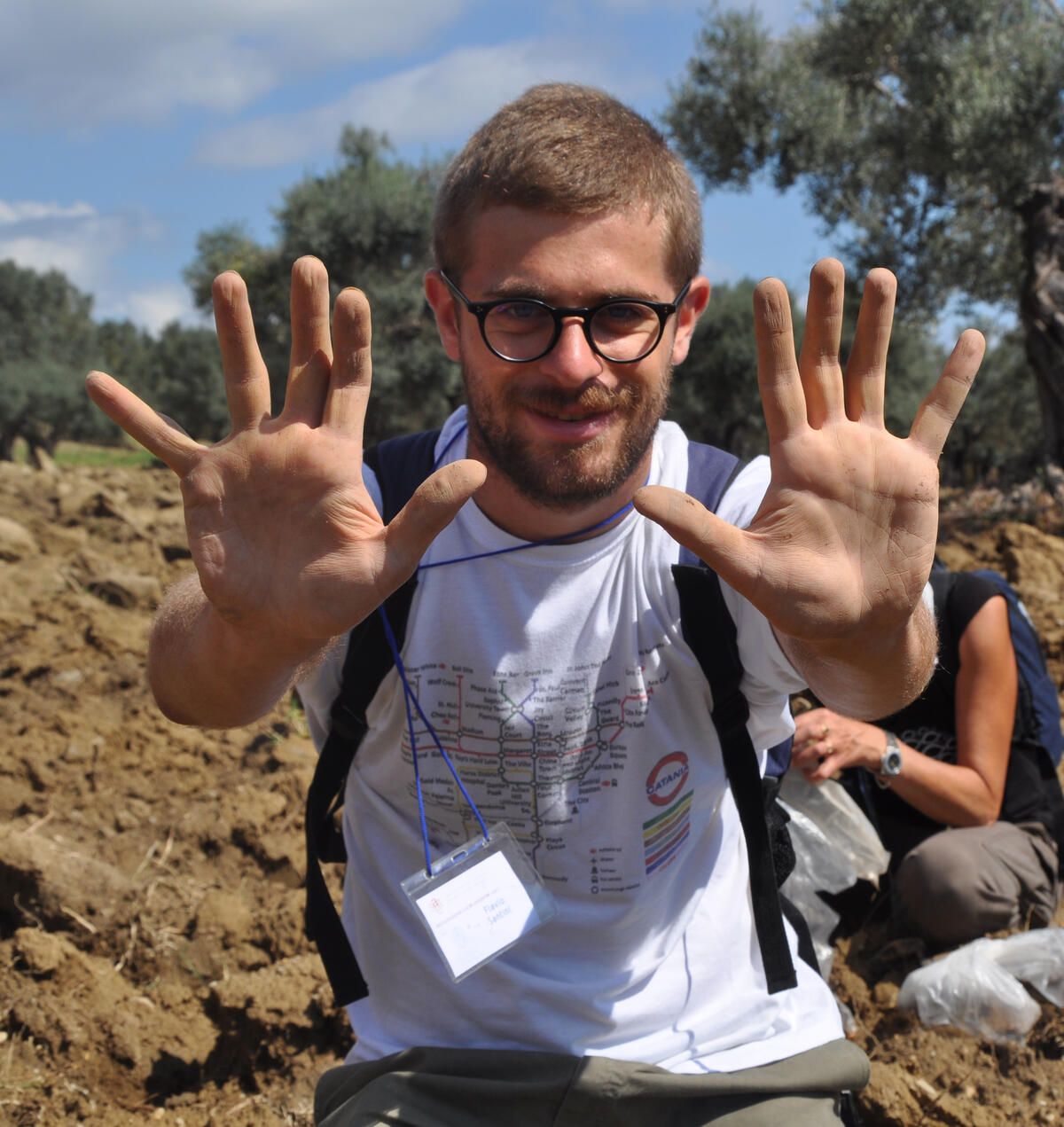
Before coming to Berkeley in Fall 2020, I was trained as an ancient historian and epigraphist in Pisa (Scuola Normale Superiore/University of Pisa), Munich (Ludwig-Maximiliens-Universität) and Vienna (ÖAW, Forschungsgruppe Epigraphik). My PhD reseaerch has been supported by the Sara B. Aleshire Center for the Study of Greek Epigraphy, the Center for Tebtunis Papyri (CTP), the Berkeley Center for the Study of Religion (BCSR), the American Numismatic Society (ANS), the Association of Ancient Historians (AHA), and the American School of Classical Studies in Athens, where I was Associate Student Member during the a.y. 2024/2025.
My dissertation, Debt and the Polis, offers the first comprehensive history of public debt in the Greek-speaking world, spanning from the fifth to the first century BCE. Combining traditional philological analysis with probabilistic modeling and insights from economic sociology, new institutionalism, monetary economics, and the theory of public debt, the dissertation investigates when and why Greek poleis began borrowing around 450 BCE. It traces the early development of public debt between ca. 400–250 BCE, exploring the role of sanctuaries as supplier of loanble capital and insfrustracture to smooth consumption; the predominance of private lenders; the economics of public borrowing in relation to other fiscal tools; and the influence of private law on the emergence of public debt and inequality—while also addressing why kings never borrowed. The dissertation then turns to the period ca. 250–50 BCE, examining changes in discourse surrounding major lenders, the decline of sacred credit, practices of borrowing and lending within federal states, the impact of Roman rule on public indebtedness, the question of whether Rome itself ever engaged in public borrowing, and the reasons why public borrowing in the Greek world never consolidated into a stable fiscal institution.
I contribute to the Supplementum Epigraphicum Graecum (SEG) as Assistant Editor (Attica, Peloponnesos, Boiotia). I have carried out epigraphic fieldwork research in Athens, Izmir, Thebes, and Nicopolis. At Vienna, I worked on archival material concerning Roman Ephesos and the Kabalis region.
Projects at various stages of completion include: a short piece on the epigraphic evidence concerning exiles at Chios, ca. 330 BCE ("A Reappraisal of Alexander’s Letter to the Chians (SEG XXII 506)"); a reedition of a new bronze tablet (AE 2020, 525 = 2021, 28) from Baetica ("The first days of Tiberius. A view from Baetica"); two papyrological pieces centering on the question of priestly use of public land and the transition to the Roman ("Priests and public land: A new sublease of royal land from Roman Tebtunis (P.CtYBR inv. 1126)”; "The highlands of Tebtunis: A topographical note to SB 22.15613.9 and its implications”); a reassessment of SEG XLIII 713, an enigmatic document from late Classical Halikarnassos concerning the sale of property of defaulting private debtors by local sanctuaries (with E. Mackil).
In Pisa (2017-2019), I have tutored high school students in Greek and Latin as part of a volunteering program organized by the Scuola Normale Superiore. At Berkeley, I have taught Latin 2 (Fall 2022) and AHMA R1B (Fall 2023) on history writing in the Greek and Roman world. In Fall 2025, I will guide discussion sections for AGRS 17A: Introduction to Archaeology of the Greek World.
Publications
Articles:
- with K.L. Zachos, "Nero and Augustus at Nicopolis. A new Inscription with aureae litterae from the Orchestra of the Theater.” In: A. Angeli, N. Papazarkadas, E. Pavlidis, K. Zachos (eds.) The Theater of Nicopolis (Monumenta Graeca et Romana; Brill) (expected 2026)
- “Νέα έμμετρα επιτύμβια από τη Νικόπολη στην Ήπειρο,” Grammateion 14 (forthcoming 2025)
-
“Martyr of Civil Wars. Ambrose on the Death of Valentinian II,” in S.Elm, K.Sessa (eds.), War and Community in Late Antiquity. Cambridge (forthcoming 2025)
- with N. Papazarkadas, "In search of the Smyrna fragment of the Athenian Standards decree (IG I-3 1453G)," ZPE 226 (2023): 82-86
- "Neue Inschriften aus der Kabalis," Philia 8 (2022): 98-112
- with N.H. Levine, "Psenkebkis, Son of Pakebkis: New and Old Documents from the Center for the Tebtunis Papyri at The Bancroft Library." BASP 59 (2022): 61-83
- with M. Gammella, “La legge efebarchica di Anfipoli. Una difesa della coerenza interna del testo.” Ricerche Ellenistiche 2 (2021): 25-38
- “New light on Artemis’ epiphany. The I.Magnesia 65a+75 and 65b+76 dilemma revisited.” ASNP 12.1 (2020): 61-100
Edited Volumes:
- (as Assistant Editor) Supplementum Epigraphicum Graecum, Volume LXX (2020 [expected December 2025])
- (as Assistant Editor) Supplementum Epigraphicum Graecum, Volume LXIX (2019 [2024])
- (as Assistant Editor) Supplementum Epigraphicum Graecum, Volume LXVIII (2018 [2023])
- (as Assistant Editor) Supplementum Epigraphicum Graecum, Volume LXVII (2017 [2022])
Reviews:
- S. Aneziri, Greek Endowments in the Classical and Hellenistic periods (Stuttgart 2025), in Bryn Mawr Classical Review (forthcoming)
Conference Panel (as organizer):
- Economy of the Sacred in the Greek-speaking Mediterranean. Co-organized with E. J. Vance (McGill University). Society for Classical Studies Annual Meeting, San Francisco, CA. January 7-10, 2026
Conference Presentations:
- Public Debt and Private Law in Classical and Hellenistic Greece, University of Tübingen, Germany. June 26-28, 2025.
- Rivisiting SEG LI 1496 from Bargylia. Institute for Advanced Study, Princeton, NJ. March 7-8, 2025.
- Nuovo epigramma funerario da Nicopolis (Epiro). Seminario Avanzato di Epigrafia Greca (SAEG IX). January 8-10, 2025.
- On the Origins of Public Debt: the 5th cent. B.C. The 2024 Association of Ancient Historians Meeting, Cambridge, MA. April, 18-21 2024.
- Like Father, Like Son. A New Document on the Accession of Tiberius from Baetica. North American Congress of Greek and Latin Epigraphy, Chicago, IL. January 8-9, 2024.
- Standardization in the Athenian Empire and Beyond: Imperial Ideologies and the Creation of Common Knowledge. Society of Classical Studies Annual Meeting, Chicago, IL. January, 4-7 2024.
- Sitologoi at work in Tebtunis, ca. 165-178 CE: Preliminary observations on BL papyri 1571, 1581v, and 1596v. Greek Papyri in the British Library A conference in memory of Federica Micucci, London. September, 25 2023.
- The transition of power between Augustus and Tiberius in a new document from Spain. Institute for Advanced Study, Princeton, NJ. March 3-4, 2023
- Aureis litteris figenda. Readability, meaning, and diffusion of (gilded) bronze letters in the East under Nero - Society of Classical Studies Annual Meeting, New Orleans, LA. January 5-8, 2023.
- Fare diplomazia attorno a una dea: Magnesia al Meandro e Artemide Leukophryene. La diplomazia delle città greche: bilanci e nuove prospettive, Pisa, Italy. December 15-16, 2022.
- Cuncta per consules incipiebant: A New Document on the Accession of Tiberius. Epigraphy Workshop, Aleshire Center for the Study of Greek Epigraphy, Berkeley, CA. March 22, 2022.
- A new Neronian Inscription from the Orchestra of the Theater of Nicopolis. Επιστημονικό Συμπόσιο για το Μεγάλο Θέατρο της Νικόπολης, Preveza, Greece. September 5-6, 2022.
- Two new documents concerning the Patron descendants’ dossier from the Center for the Tebtunis Papyri at The Bancroft Library. XXXe Congrès international de Papyrologie, Paris, France. July 25-30, 2022.
- The Emperors’ Reliquiae. Ambrose and the Making of Late Antique Imperial Manliness. ABMS Cluster - PhD Symposion, Vienna. June 28, 2021.
- Shaping an epigraphical dossier in Magnesia on the Maeander: the Leukophryena ‘archive’. The International Conference in Classics and Ancient History, Coimbra, Spain. June 22-25, 2021.
The Economy of the Greek and Roman world; Public Debt; Credit; Magnesia on the Maeander; Classical and Hellenistic stasis; ancient ephebeia; the public epigraphy of the early Roman empire; Roman Tebtunis; Ambrose and Late Antique imperial representation.